
Kimi K2 Explained: Moonshot AI’s Trillion-Parameter Open-Weight Model
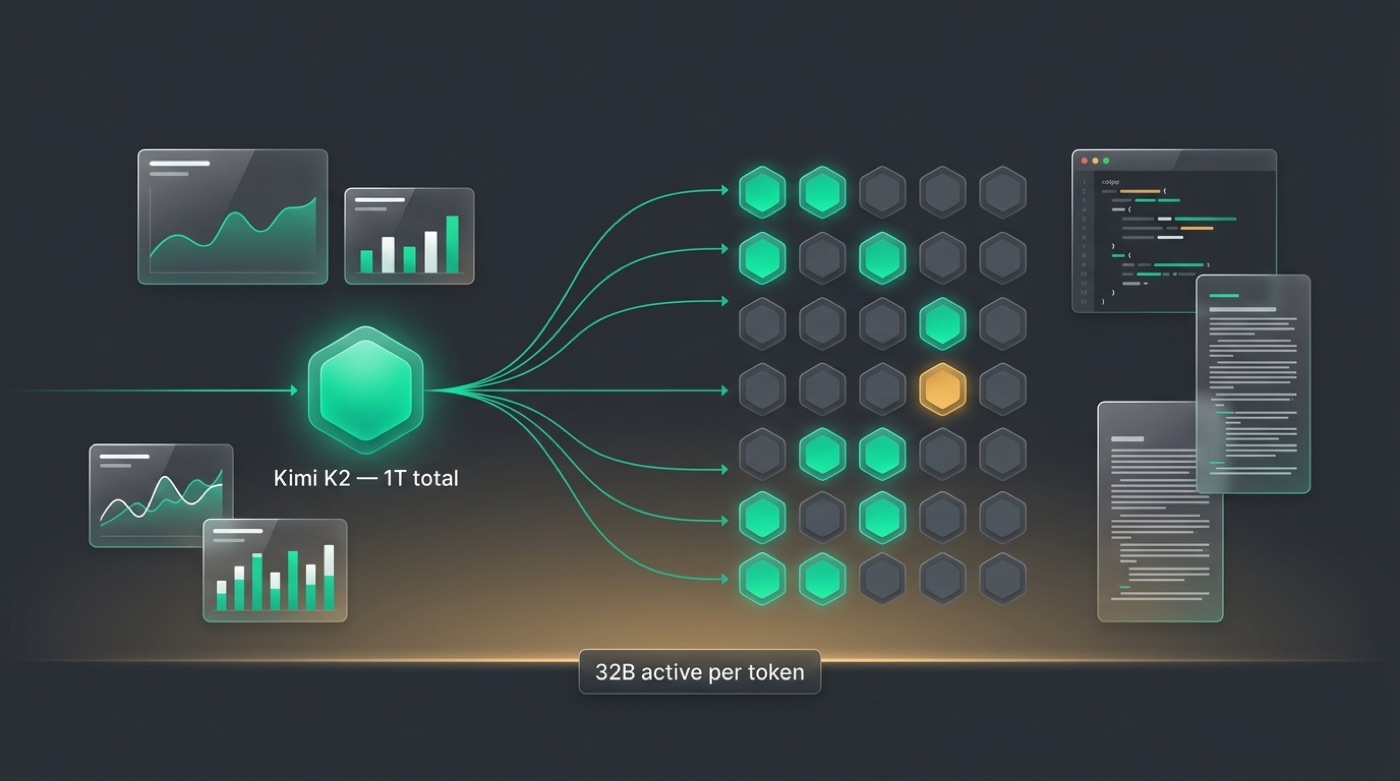
Kimi K2 is a Mixture-of-Experts language model released by Moonshot AI in July 2025, with 1 trillion total parameters and 32 billion active per token. It is the open-weight flagship of the kimi moonshot ai lineup, according to the model’s Wikipedia entry.
The weights are published under a Modified MIT License and hosted on Hugging Face and GitHub, and the model is built specifically for agentic, tool-using tasks rather than plain chat. This is an unofficial site, not affiliated with Moonshot AI. For the official product visit kimi.com.
What Is Kimi K2?
Kimi K2 is an open-weight large language model in Moonshot AI’s Kimi family, released in July 2025. “Open-weight” here means the trained parameters themselves are downloadable and runnable on your own hardware, unlike a fully closed model where you only get API access. Moonshot AI’s own technical report is titled “Kimi K2: Open Agentic Intelligence,” credited to the Kimi Team, and that phrase captures the model’s positioning: it is designed less as a conversational toy and more as a base for autonomous, multi-step agent workflows that call tools and execute code.
Moonshot AI itself was founded in Beijing in March 2023 and is frequently grouped among China’s “six AI tigers,” an informal label for the country’s leading generative-AI startups. Kimi K2 is the company’s most technically ambitious public release to date, combining a Mixture-of-Experts (MoE) architecture with training techniques aimed at large-scale stability.
Kimi K2 at a glance
- Developer — Moonshot AI
- Released — July 2025
- Type — Mixture-of-Experts (MoE) large language model
- Size — 1 trillion total parameters / 32 billion active per token
- License — Modified MIT License
- Access — Hugging Face, GitHub, kimi.com
Architecture and Parameters
A Mixture-of-Experts design like Kimi K2’s means the model is broken into many specialized sub-networks (“experts”), and only a small subset of them fires for any given token. Practically, that lets Kimi K2 carry the knowledge capacity of a 1-trillion-parameter model while running each forward pass at something closer to the compute cost of a 32-billion-parameter dense model. This is the same basic idea behind DeepSeek’s MoE releases, though the routing details and training recipe differ.
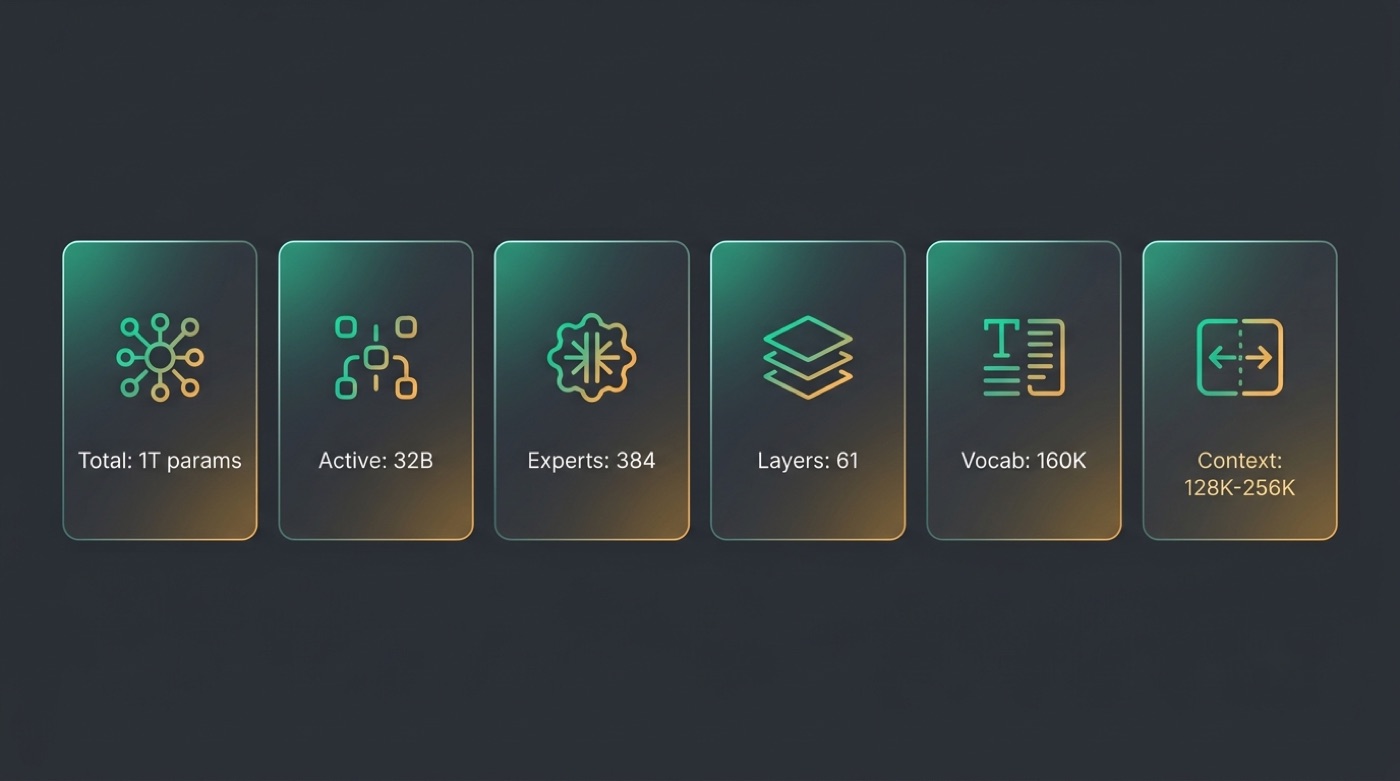
According to the official Hugging Face model card, Kimi K2 activates 8 of its 384 experts per token plus one always-on shared expert, spread across 61 layers (60 of which are MoE layers, one dense). It uses Multi-head Latent Attention (MLA) and SwiGLU activations, a 160K-token vocabulary, and an attention hidden dimension of 7,168. Base context length is 128K tokens, extended to 256K in the Kimi-K2-Instruct-0905 update.
Specs table
| Spec | Value |
|---|---|
| Total parameters | 1 trillion |
| Active parameters per token | 32 billion |
| Experts | 384 (8 active + 1 shared) |
| Layers | 61 |
| Attention mechanism | Multi-head Latent Attention (MLA) |
| Activation function | SwiGLU |
| Vocabulary size | 160,000 tokens |
| Context window | 128K (256K in Instruct-0905) |
These figures come from the official Hugging Face model card; check it directly for the most current specification.
How Kimi K2 Was Trained
Moonshot AI pre-trained Kimi K2 on 15.5 trillion tokens, and the technical report describes the run as achieving zero loss spikes — meaning the training loss curve stayed stable without the sudden divergences that often force restarts on runs of this scale. That stability is credited to the Muon optimizer, scaled up for a trillion-parameter model, combined with a technique the team calls MuonClip, which adds QK-clipping to keep attention logits from blowing up during training.
Post-training moves beyond standard instruction tuning: Moonshot AI describes large-scale synthesis of agentic data — simulated multi-step tasks involving tool use — paired with joint reinforcement learning across both reasoning and agentic objectives. The arXiv technical report is the primary source for these training claims.
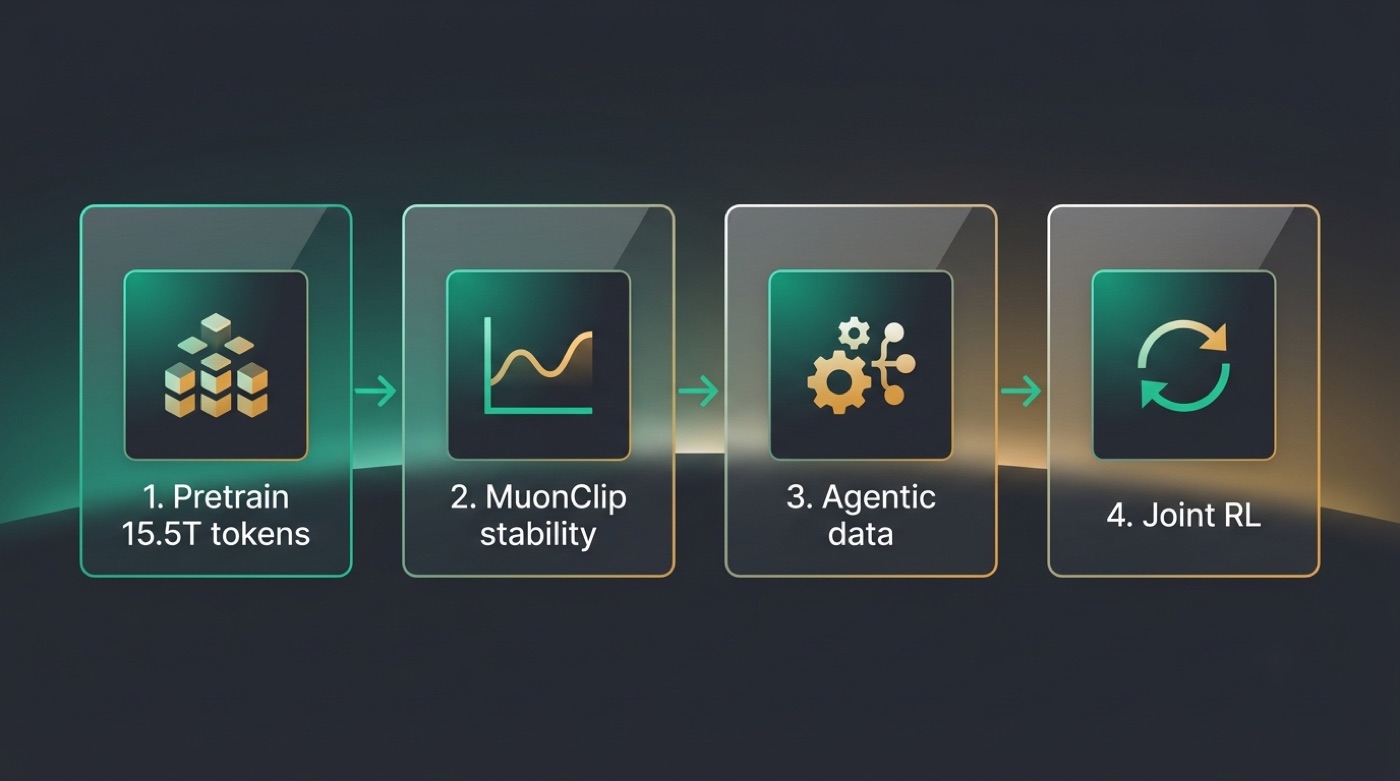
Kimi K2 is pre-trained on 15.5 trillion tokens with zero loss spike, using MuonClip, a novel QK-clip technique to address training instability.
Kimi Team, “Kimi K2: Open Agentic Intelligence”
That framing — captured in the technical report’s own title, “Open Agentic Intelligence” — signals what the training pipeline was optimized for: not just fluent text generation, but reliable execution of tool-calling and agentic sequences.
Training highlights, per the official report:
- Muon optimizer scaled to a trillion-parameter MoE model
- MuonClip / QK-clip technique added for large-scale stability
- 15.5 trillion training tokens with no reported loss spikes
- Large-scale synthetic agentic-task data in post-training
- Joint reinforcement learning across reasoning and agentic objectives
Kimi K2 Benchmarks (Vendor-Reported)
The following figures are reported by Moonshot AI in the Kimi K2 paper and model card and have not been independently verified here — always check the official page for current numbers before citing them elsewhere.
Benchmark table
| Benchmark | Reported score | What it measures |
|---|---|---|
| SWE-bench Verified | 65.8 | Real-world software-engineering task resolution |
| LiveCodeBench v6 | 53.7 | Contamination-resistant coding ability |
| MMLU | 89.5 | Broad multitask academic knowledge |
| Tau2-Bench | 66.1 | Tool-use / agentic task completion |
| AIME 2025 | 49.5 | Competition-level mathematics |
| GPQA-Diamond | 75.1 | Graduate-level science reasoning |
As reported by Moonshot AI; verify on the official model card before relying on any single figure.
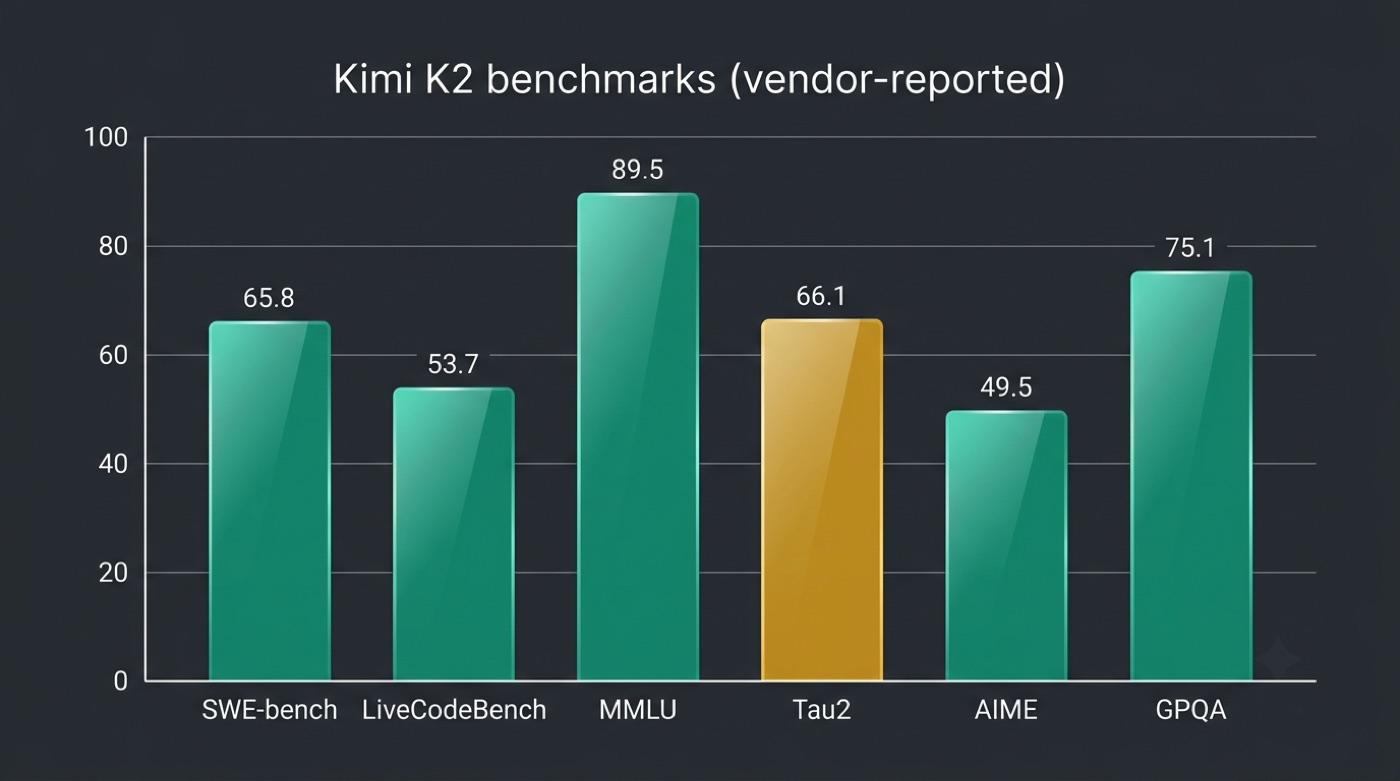
Across these categories, Moonshot AI positions Kimi K2 particularly around SWE-bench Verified and Tau2-Bench — the two benchmarks most tied to the “agentic intelligence” framing, since both test whether a model can complete multi-step tasks with tools rather than just answer a static question.
Model Variants: Base, Instruct and Updates
Moonshot AI ships Kimi K2 as two core checkpoints, plus incremental updates layered on top of the Instruct line.
- Kimi-K2-Base — the raw foundation model, intended for researchers and teams who want to fine-tune it themselves rather than use it directly for chat.
- Kimi-K2-Instruct — post-trained for conversational and agentic use. Moonshot AI describes it as a “reflex-grade” model, meaning it responds directly without an extended internal “thinking” phase before answering.
- Kimi-K2-Instruct-0905 — an update dated September 5, 2025 that expanded the context window from 128K to 256K tokens, among other refinements.
Moonshot has continued to ship updates since these releases, and names referencing later point versions have appeared in various places online. Treat any such naming as unconfirmed here — for the latest variant and version numbers, check the official model card directly.
License and Open Weights
Kimi K2’s code and model weights are both released under a Modified MIT License, one of the more permissive terms available for an open-weight model of this scale. Weights are hosted at huggingface.co/moonshotai, and inference/training code lives on github.com/MoonshotAI.
In plain terms, “open-weight under Modified MIT” means you can download the full parameter set, run it on your own infrastructure, and build on it — but “modified” signals the license carries deviations from the standard MIT template, so it is worth reading the actual license text on the repository rather than assuming it matches a vanilla open-source license word for word.
How to Access and Run Kimi K2
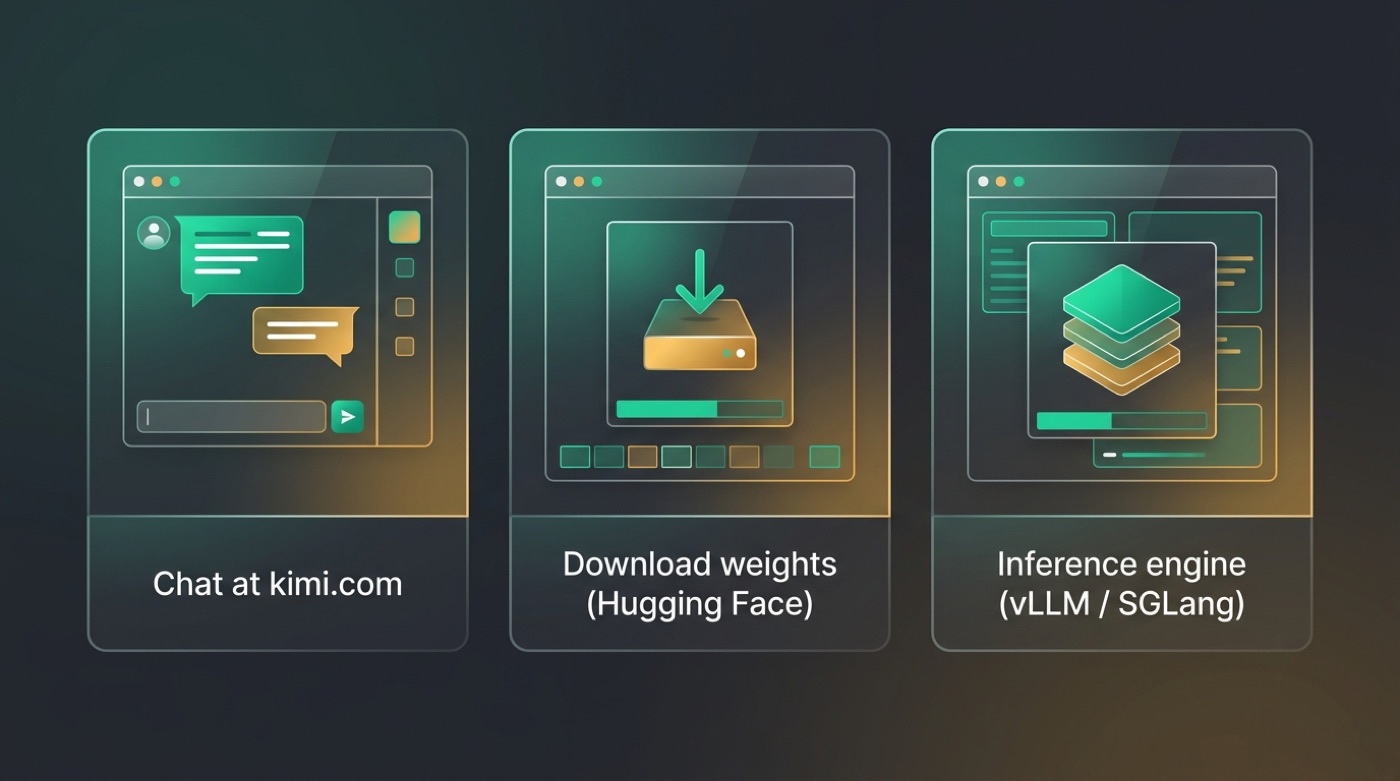
There are three practical routes to using Kimi K2, depending on how much infrastructure you want to manage:
- Chat at kimi.com (or kimi.moonshot.cn) — no installation, no hardware requirements, immediate access through Moonshot AI’s own web interface.
- Download the weights from Hugging Face and self-host — gives full control but requires the technical setup to serve a trillion-parameter model.
- Run it through an inference engine such as vLLM, SGLang, KTransformers, or TensorRT-LLM — these frameworks handle the MoE routing and memory management needed to serve the model efficiently.
Self-hosting a model this size is not a casual undertaking: even with only 32 billion parameters active per token, storing and serving the full trillion-parameter weight set requires substantial multi-GPU or high-memory infrastructure. For most people who just want to experiment with Kimi-style prompts without provisioning hardware, a hosted kimi ai chat is the fastest starting point — though for the official product and the latest model updates, the authoritative source is always kimi.com.