
Kimi vs ChatGPT: How Moonshot AI’s Assistant Compares to OpenAI’s
Kimi and ChatGPT are separate products built by separate companies: Kimi comes from China’s kimi moonshot ai, and ChatGPT comes from OpenAI in the US. Neither is a clone of the other — they were trained and released independently, and Moonshot AI’s own history is documented on Wikipedia.
This is an unofficial site, not affiliated with Moonshot AI. For the official product visit kimi.com.
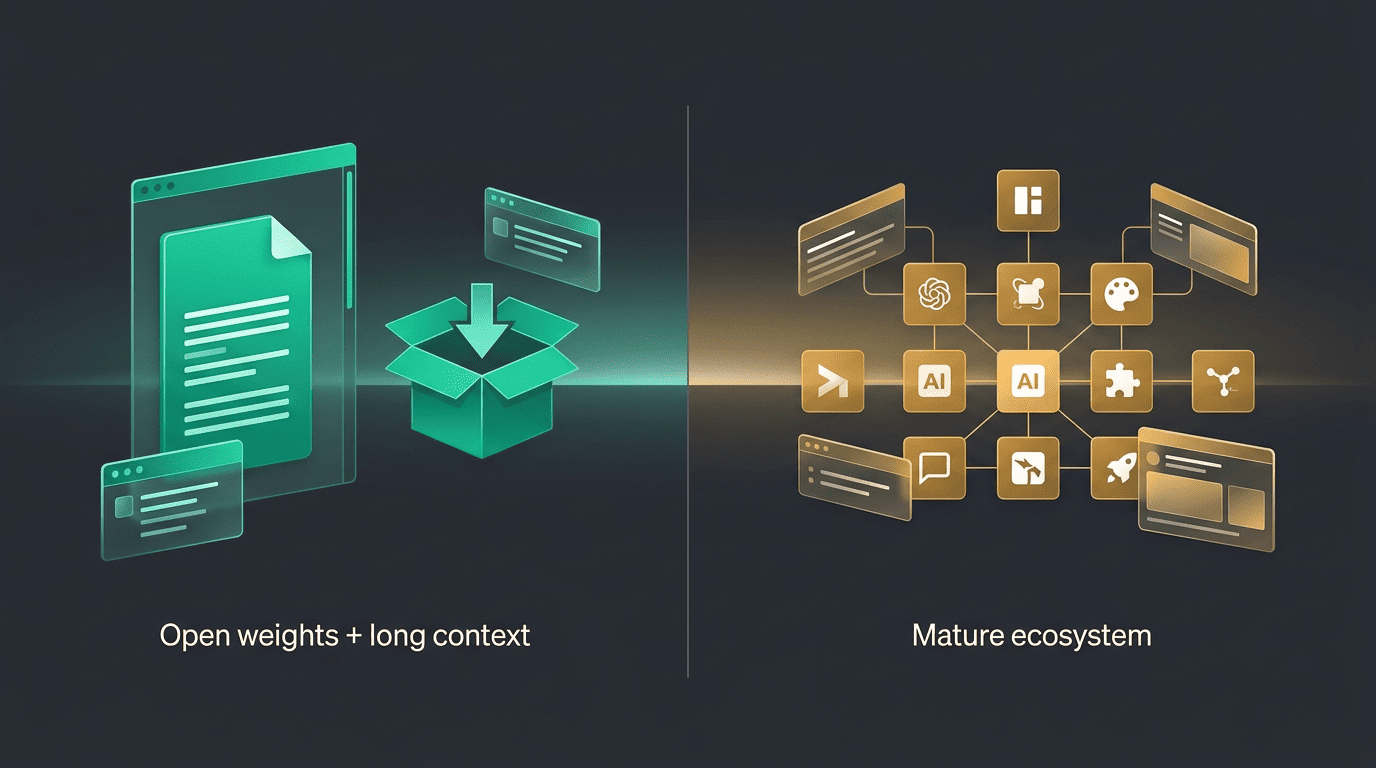
Kimi’s edge is a very long context window paired with open weights that developers can self-host; ChatGPT’s edge is years of maturity and a wide integration ecosystem. What follows is a qualitative comparison — exact model versions, benchmark numbers, and prices change often on both sides, so treat any specific figure as something to verify on the vendor’s own page rather than a fixed fact.
Kimi vs ChatGPT at a Glance
Both are chat-first AI assistants with a hosted web app, a mobile experience, and a developer API, and both ship new model versions on a fast cadence. The table below lays out the directional differences without assigning either one a numeric score.
| Dimension | Kimi | ChatGPT |
|---|---|---|
| Maker | Moonshot AI | OpenAI |
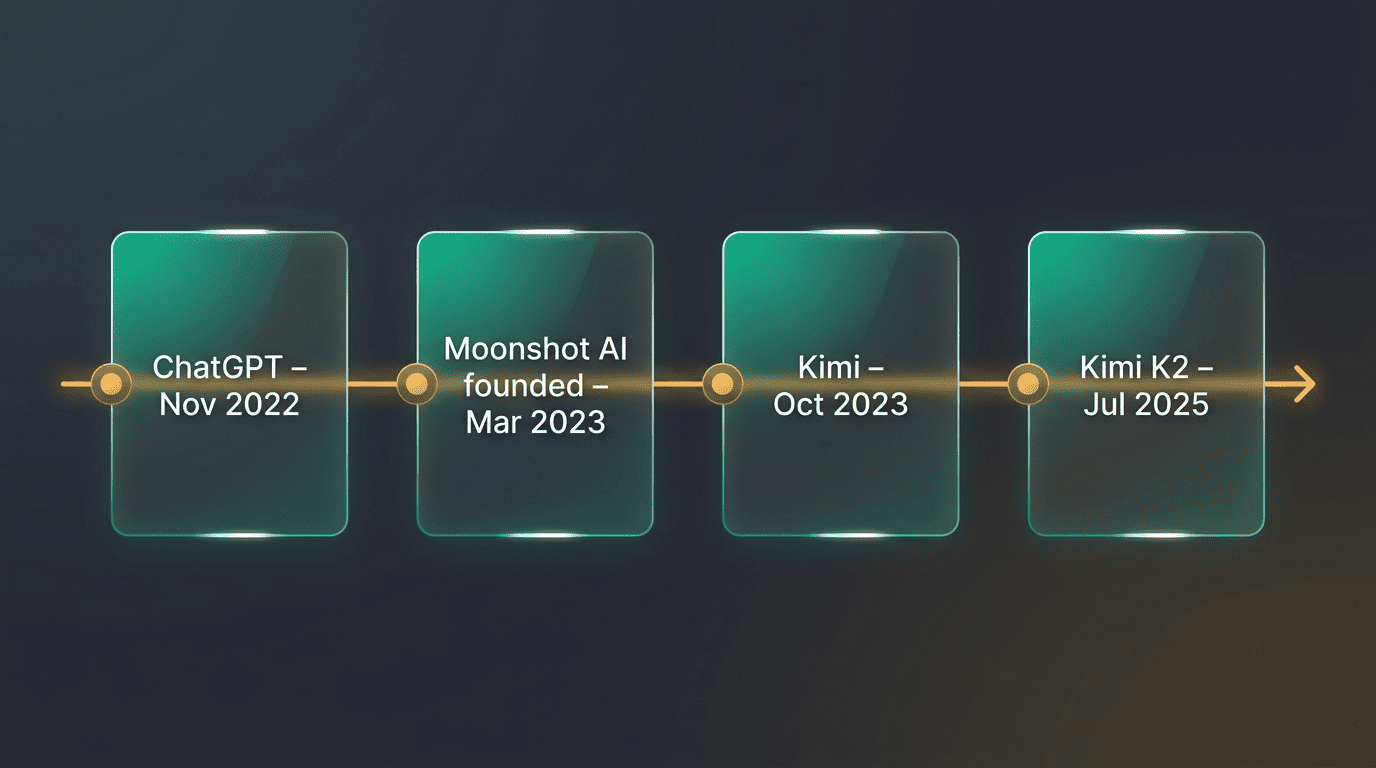
| Origin | Beijing, founded March 2023 | US, ChatGPT launched publicly late November 2022 |
| Current flagship model | Kimi K2 (open weights, Jul 2025) | GPT-5.6 Sol |
| Signature strength | Long context window, open weights | Mature ecosystem, broad integrations |
| Model access | Open weights (self-hostable) plus hosted app | Closed, hosted only |
A few traits they share:
- Both are conversational AI assistants built around a large language model core.
- Both offer a free hosted chat interface alongside a paid or metered API.
- Both companies iterate quickly, shipping new model generations within months of each other.
- Both compete for the same general use cases — writing, coding help, research, and document analysis.
Read the table as directional rather than scored: it tells you where each product tends to lean, not which one wins a given benchmark.
Who Makes Each: Moonshot AI vs OpenAI
Kimi and ChatGPT trace back to two very differently positioned companies, and that lineage shapes how each product is built and released.
Moonshot AI, the maker of Kimi
Moonshot AI was founded in March 2023 by three Tsinghua schoolmates — Yang Zhilin, Zhou Xinyu, and Wu Yuxin — and is headquartered in Beijing. It’s commonly grouped among China’s “6 AI Tigers,” the informal label given to the country’s leading generative-AI startups. Alibaba led a $1 billion funding round into the company in February 2024, a signal of how quickly Moonshot AI’s ambitions scaled. Kimi is the company’s consumer-facing chatbot and the product most people associate with the Moonshot name.
OpenAI, the maker of ChatGPT
OpenAI is a US company, and ChatGPT launched publicly in late November 2022, effectively popularizing the modern AI-chat format that Kimi and dozens of other assistants now follow. It runs on OpenAI’s GPT model family, whose current flagship is GPT-5.6 Sol. To answer one recurring question directly: is Kimi a ChatGPT clone? No — Kimi was built independently by Moonshot AI, on its own models and infrastructure, not as a copy of OpenAI’s product. Exact current OpenAI corporate details and version names shift often enough that they’re worth checking directly on OpenAI’s official pages rather than assuming.
Design and Strengths: Long Context, Open Weights, Ecosystem
The two products optimized for different things from the start, and that shows up most clearly in how each handles context length and model access.
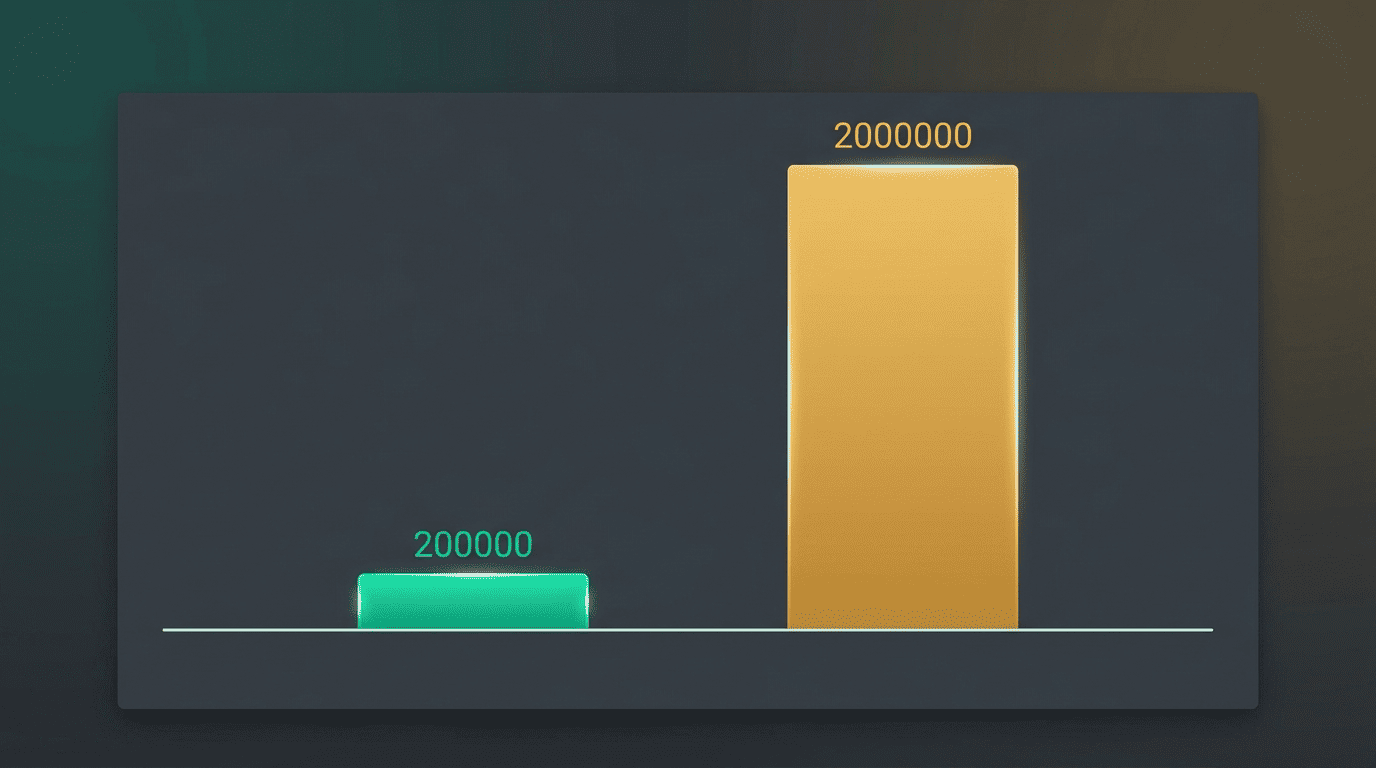
- Very long inputs. Kimi’s calling card is how much text it can hold in a single conversation. It launched in October 2023 supporting up to 200,000 Chinese characters, then Moonshot AI upgraded that to roughly 2 million Chinese characters in March 2024 — enough to load entire books or large codebases into one session rather than chunking them.
- Open, downloadable weights. Kimi K2, released as open weights in July 2025, is a Mixture-of-Experts model with 1 trillion total parameters and 32 billion active per token, published so developers can download and self-host it rather than only calling it through an API.
- A stated reasoning benchmark. Kimi K1.5, released January 20, 2025, is a model that Moonshot AI says reaches parity with OpenAI’s o1 on math, coding, and multimodal reasoning tasks — that is Moonshot’s own claim about its model, not an independently verified result, so treat it as a vendor statement rather than settled fact.
Moonshot AI is one of a handful of Chinese startups — nicknamed the “AI Tigers” — racing to build large language models that rival those from the US, and its Kimi chatbot has drawn attention for supporting unusually long context windows.— adapted from the Moonshot AI entry on Wikipedia
ChatGPT’s ecosystem and maturity
ChatGPT sits on the other side of that trade-off. It is a closed, hosted product — you cannot download its weights — but it comes with a large, mature ecosystem: first-party apps across platforms, a broad plugin and integration landscape, and years of third-party tooling built around its API. Its current flagship, GPT-5.6 Sol, is widely regarded as strong on general-purpose and English-language tasks. Exact context limits, benchmark figures, and pricing change frequently enough on OpenAI’s side that this article won’t put numbers on them — check OpenAI’s official pages for what’s current — but the head-to-head framing here is Kimi’s long context and open weights against GPT-5.6 Sol’s mature, closed ecosystem.
Language, Access and Availability
How you reach each assistant, and how well it handles a given language, differs enough to matter for anyone choosing between them.
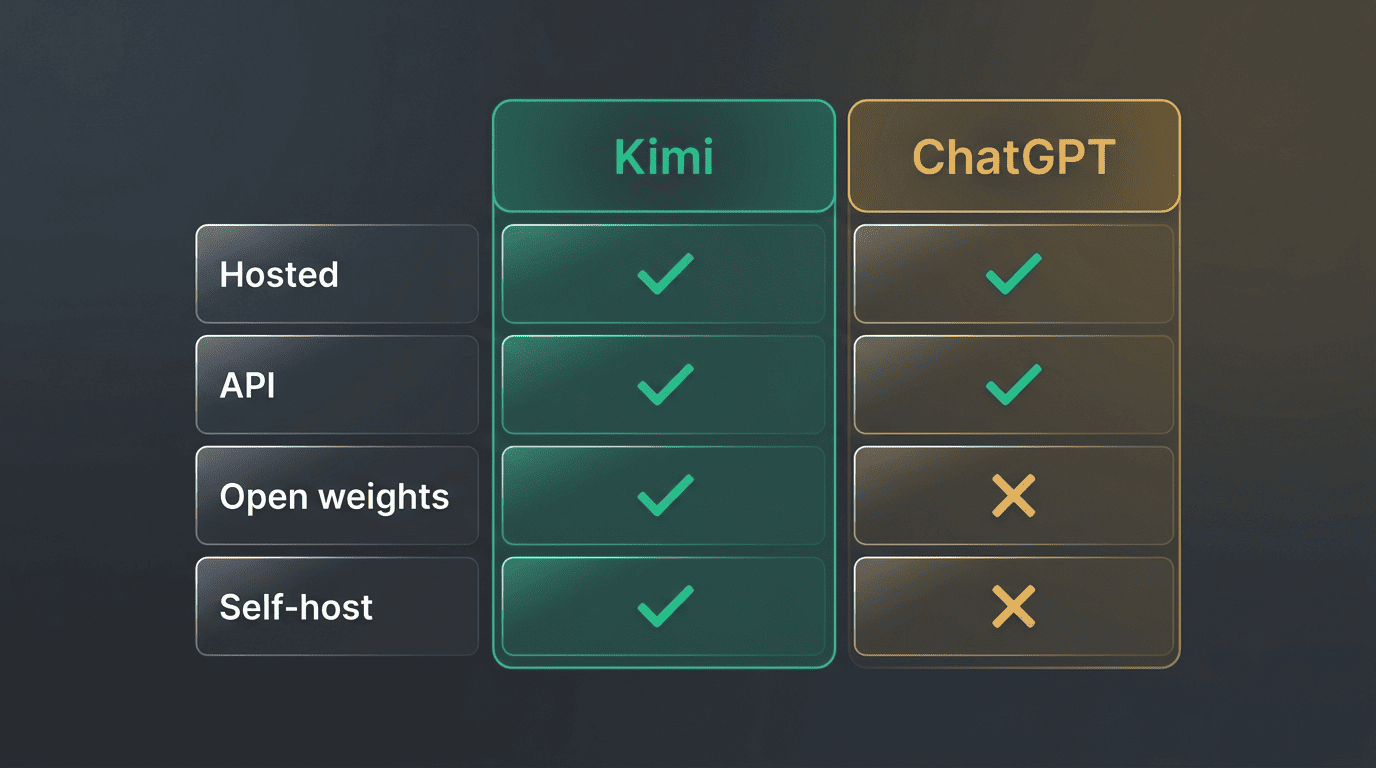
- Hosted chat. Kimi is available at kimi.com; ChatGPT is available through OpenAI’s own hosted app.
- API access. Both offer a developer API for building the model into other software.
- Open weights. Kimi’s weights are published on huggingface.co/moonshotai and on GitHub, so teams can self-host; ChatGPT has no equivalent open-weight release.
- Self-hosting. Because Kimi’s weights are open, it can run on infrastructure you control; ChatGPT can only be accessed through OpenAI’s hosted service.
- Language strength. Kimi has historically been strongest on Chinese-language tasks and very long documents; ChatGPT is broadly multilingual with particular strength in English.
| Access channel | Kimi | ChatGPT |
|---|---|---|
| Hosted web/app | Yes, at kimi.com | Yes, closed hosted |
| Developer API | Yes | Yes, closed hosted (reported) |
| Open weights | Yes — Hugging Face, GitHub | No |
| Self-host option | Yes, via open weights | No |
That access matrix is textual by design — neither column carries a performance score, just what mode of access each product actually offers.
Which Should You Choose?
There’s no single winner here, only a better fit for a given task:
- Choose Kimi if you regularly work with very long documents or codebases that need to fit in one context window.
- Choose Kimi if you want open weights you can self-host, fine-tune, or run on your own infrastructure.
- Choose Kimi if a meaningful share of your work is in Chinese.
- Choose ChatGPT if you rely on a mature ecosystem of integrations, plugins, and third-party tooling.
- Choose ChatGPT if broad general-purpose, English-first performance matters more than context length or open weights.
Whichever direction you lean, remember that both products ship new versions on a fast cycle, and any leaderboard snapshot goes stale quickly — the most reliable way to judge current capability is to try a real task yourself through kimi ai chat and compare it against ChatGPT directly, then check kimi.com and OpenAI’s site for what each currently claims.