
Moonshot AI: The Chinese Startup Behind Kimi
Moonshot AI is the Beijing startup that builds Kimi moonshot ai, one of China’s most closely watched AI assistants. According to Wikipedia, the company was founded in March 2023 and is counted among China’s “6 AI Tigers.”

This is an unofficial site, not affiliated with Moonshot AI. For the official product visit kimi.com. Backed by Alibaba and Tencent, the company has gone from a $300M seed valuation to multi-billion-dollar territory in under two years.
What is Moonshot AI?
Moonshot AI is a private AI company headquartered in Beijing. Founded in March 2023, it employs roughly 300 people as of 2026 and is best known outside China for one product: the Kimi chatbot. The company sits at the center of China’s push to build frontier AI labs that can compete with their American counterparts, and its research output — from serving infrastructure to math-proving models — has made it a name that shows up regularly in industry coverage of the sector.
A frontier AI lab from Beijing
The company is private, headquartered in Beijing, and was founded in March 2023. It’s best known for the Kimi chatbot, which handles long-context conversations, document analysis, and agentic tasks. For a full breakdown of what the assistant does and how to use it, see what Kimi is.
| Attribute | Detail |
|---|---|
| Founded | March 2023 |
| Headquarters | Beijing, China |
| Employees | ~300 (2026) |
| Ownership | Private |
| Flagship product | Kimi chatbot |
| Standing | One of China’s “6 AI Tigers” |
The name: “Dark Side of the Moon”
The company’s Chinese name, 月之暗面, translates to “Dark Side of the Moon” — a direct nod to Pink Floyd’s 1973 album. It’s a deliberate signal: the founders picked a name associated with ambition, mystery, and reaching for something largely unexplored, which lines up with the company’s stated goal of building toward artificial general intelligence.
Who founded Moonshot AI?
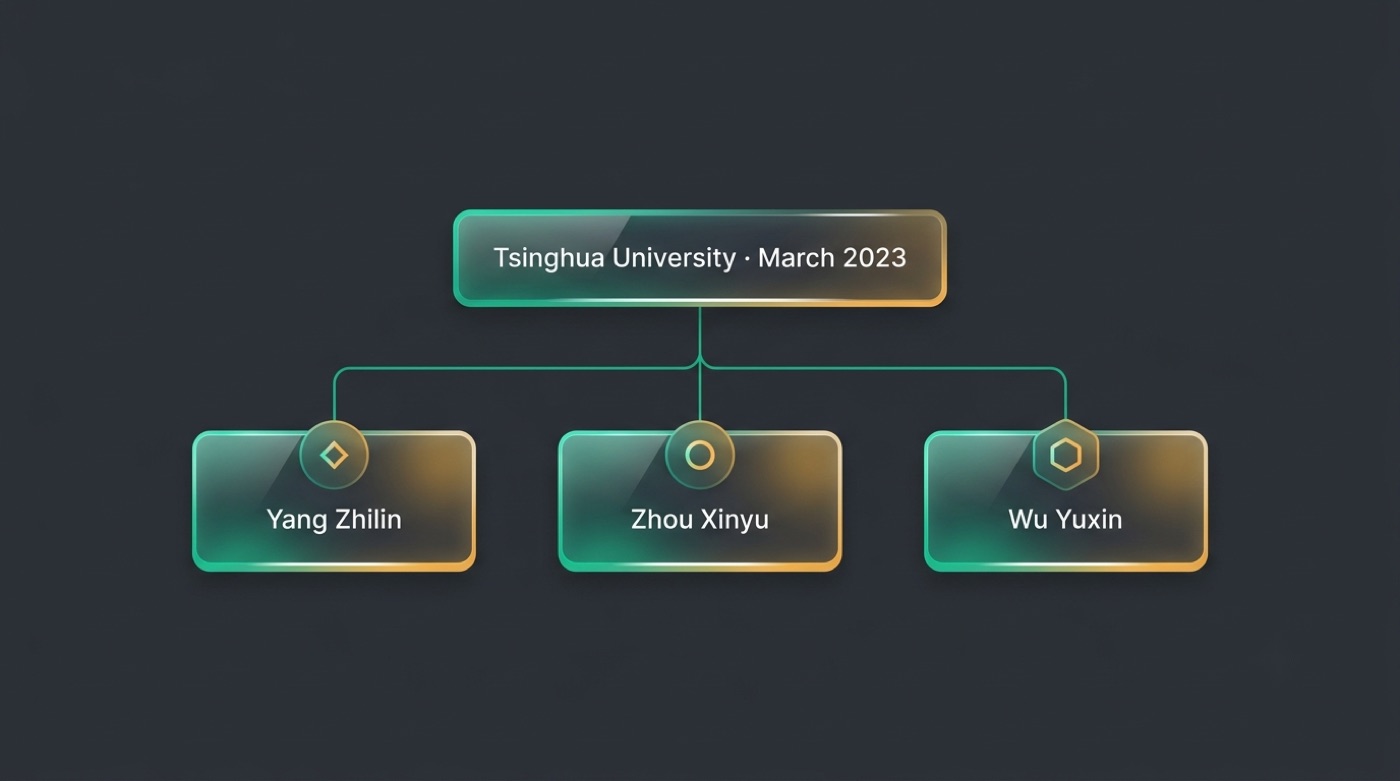
Moonshot AI was founded in March 2023 by three schoolmates from Tsinghua University. Between them they bring backgrounds in machine learning research and natural language processing, and the founding trio has stayed intact as the company scaled from a small research team to a multi-billion-dollar startup.
The three founders
- Yang Zhilin — the most publicly visible of the three and widely reported as the company’s CEO (verify current title on official channels).
- Zhou Xinyu — co-founder, part of the original founding team.
- Wu Yuxin — co-founder, part of the original founding team.
All three met as students at Tsinghua University before founding the company together in March 2023.
The Tsinghua connection
Tsinghua University in Beijing is one of China’s top engineering and computer-science schools, and it has produced founders across several of the country’s leading AI labs. Moonshot AI’s origin story — a small group of Tsinghua-trained researchers spinning out to build a frontier lab — follows a pattern common among China’s newer generative-AI startups, several of which draw talent from the same handful of universities and prior research labs.
Funding and valuation
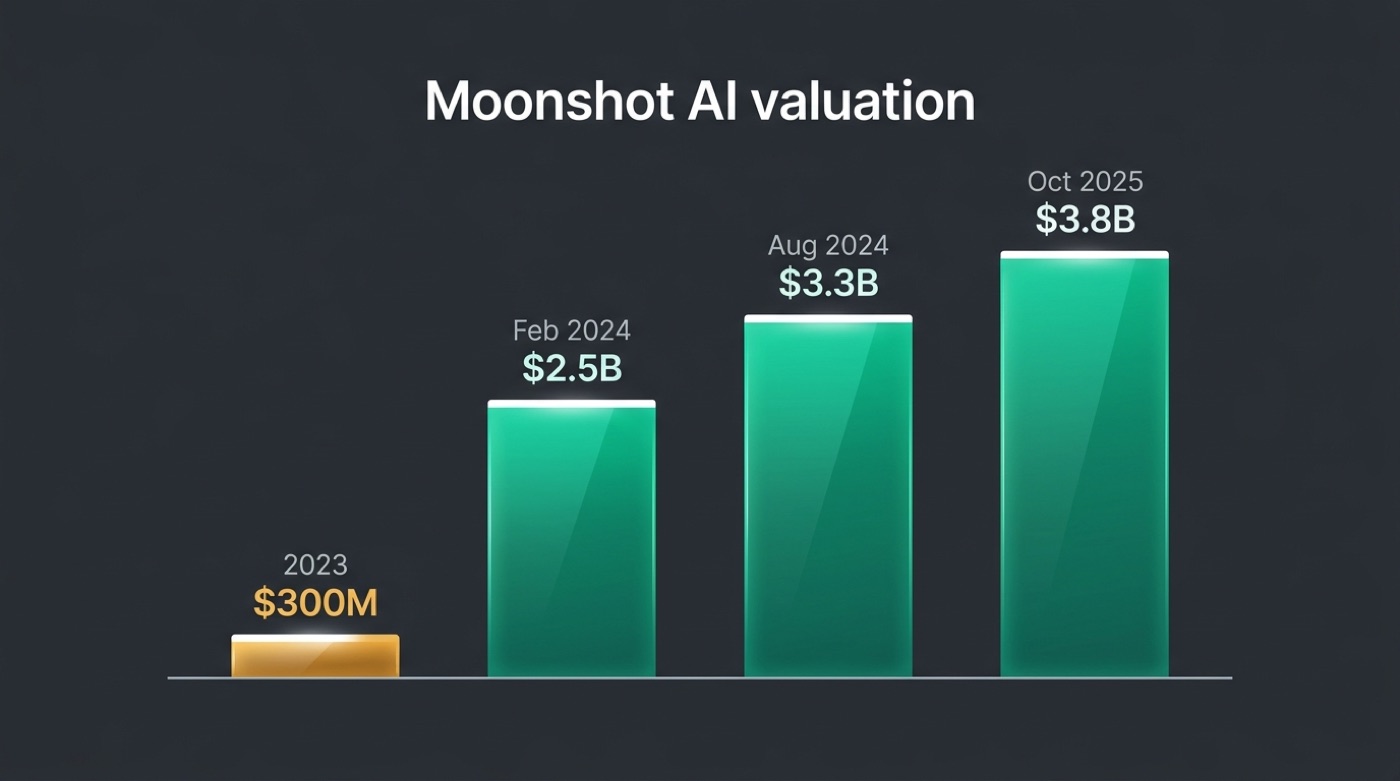
Alibaba Group… led a $1 billion funding round in Moonshot AI in February 2024, valuing the startup at about $2.5 billion and giving Alibaba roughly a 36% stake. — Moonshot AI, Wikipedia
Moonshot AI’s investor list reads like a who’s-who of Chinese tech and capital: Alibaba Group, Tencent, Gaorong Capital, and IDG Capital have all backed the company across four rounds since its founding.
The big rounds
| Round | Date | Amount | Valuation (post-money unless noted) | Lead investor(s) |
|---|---|---|---|---|
| Seed | 2023 | $60M | $300M | — |
| Alibaba-led round | Feb 2024 | $1B | $2.5B | Alibaba Group (~36% stake) |
| Tencent-led round | Aug 2024 | $300M | $3.3B | Tencent, Gaorong Capital |
| IDG-led round | Oct 2025 | ~$600M | $3.8B (pre-money, per Wikipedia) | IDG Capital |
Valuation trajectory
The trajectory from a $300M seed valuation to a reported $3.8B in roughly two years is steep, even by the standards of China’s AI funding boom. Alibaba’s $1 billion round in February 2024 alone matched more than three times the company’s prior valuation. Treat the most recent figures as directional — funding rounds in fast-moving AI startups get revised and re-reported often, so verify the latest numbers against the sources above or Moonshot AI’s own announcements before citing them.
One of China’s “6 AI Tigers”
“6 AI Tigers” is an informal industry label for the group of Chinese generative-AI startups seen as the country’s leading challengers to American frontier labs. Moonshot AI is consistently named as one of them.
What the “6 AI Tigers” means
The term groups together a handful of well-funded Chinese startups that emerged in the wake of ChatGPT’s launch, each racing to build large language models and consumer-facing AI products at a pace comparable to OpenAI, Anthropic, and Google. Moonshot AI’s inclusion in this group reflects both its funding scale (backed by Alibaba and Tencent) and its product traction with Kimi. Specifics about the other members and their relative standing shift often enough that they’re best verified against current reporting rather than treated as fixed.
Products and research
Moonshot AI’s product lineup centers on Kimi but extends into infrastructure and research that most casual users never see directly.
The Kimi product family
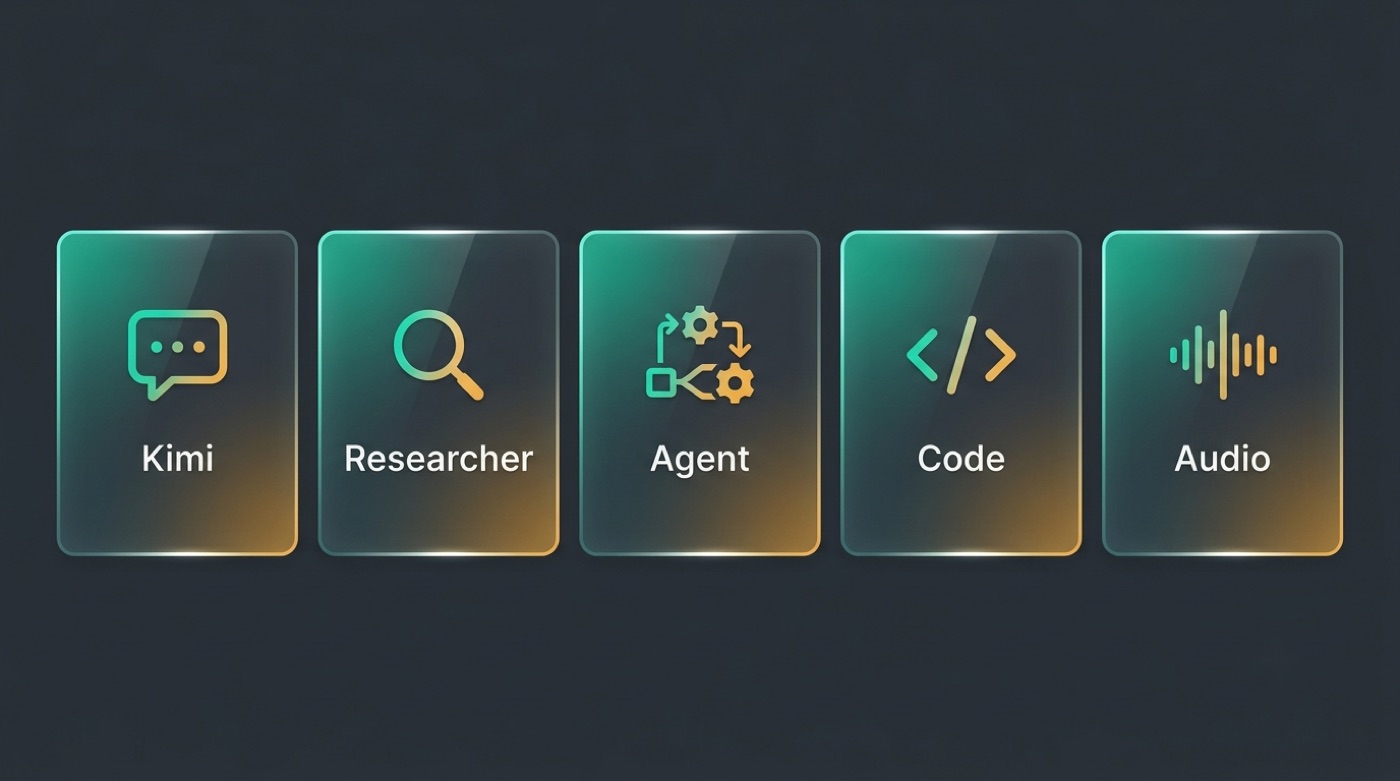
- Kimi — the flagship conversational assistant, available at kimi.com.
- Kimi Researcher — a research-focused agent mode built for multi-step investigation tasks.
- Kimi Agent — an agentic mode for executing multi-step tasks rather than single-turn chat.
- Kimi Code — a coding-oriented variant of the assistant.
- Kimi Audio — audio-related capabilities within the product family.
For details on how the core chatbot works day to day, see what Kimi is.
Open research and infrastructure
Beyond the consumer product, Moonshot AI publishes research and open weights that other developers and researchers can build on:
- Kimina Prover — the company’s math-focused theorem-proving model.
- Mooncake — its serving platform for large-scale model inference.
- Muon optimizer — an optimizer used in training the company’s models.
- RL-with-LLMs research — reinforcement-learning work applied to large language models.
The company also open-sources model weights and code, hosted at huggingface.co/moonshotai and github.com/MoonshotAI. Specifics on any model released after Kimi K2 — including version numbers, benchmark scores, or pricing — should be verified directly on kimi.com or the company’s official channels, since this space moves fast and unverified claims circulate quickly.
How to verify current Moonshot AI facts
- Start with the Wikipedia page on Moonshot AI for a sourced overview of funding and history.
- Check the Kimi (chatbot) Wikipedia entry for product-specific background.
- Visit kimi.com directly for the current product lineup and pricing.
- Check huggingface.co/moonshotai for the latest published model weights.
- Check github.com/MoonshotAI for open-source code and research releases.
- Cross-reference any funding or valuation figure against at least two sources before citing it, since these numbers get revised as new rounds close.